Today, South Africa needs the Public Value Governance (PVG) programme to ensure that public servants are real change agents, enablers and facilitators of integrated good governance and public administration marching forward towards Vision 2030.
This was revealed by the member of the APR Panel of Eminent Persons, Ambassador Sibusiso Ndebele while delivering the keynote address at the launch of the new public governance approach initiative aimed at identifying democratic and citizen-empowering alternatives – the PVG in Durban on Wednesday, 03 June 2026.
“Indeed, South Africa is a changed country compared to the one we inherited 32 years ago. Today, the ethos of Batho Pele (Putting People first) Principles finds its expression in the Constitution which dictates that public administration must be accountable, while transparency must be fostered by providing the public with timely, accessible, and accurate information.
“In the new South Africa we live in today, we need the PVG to ensure that we have public servants who are real change agents, enablers and facilitators of integrated good governance and public administration marching forward towards Vision 2030.
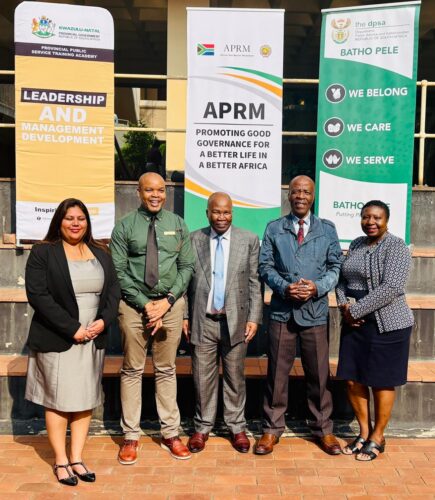
“At the heart of this transformation lies Public Value Governance or PVG – a framework that challenges us to rethink how we design policies, deliver services, and engage citizens. It moves us beyond the traditional hierarchal models of governance and efficiency driven approaches, towards a system where the ultimate measure of success is the value we create for society,” he said.
As the country embarks on this irreversible journey, he asked the people gathered at the launch, a crucial question: How do we translate this vision into practical, measurable outcomes? According to Ambassador Ndebele, one of the instrumental answers lies in harnessing the complementarity between the African Peer Review Mechanism (APRM) and the Open Government Partnership (OGP).
The former KwaZulu-Natal Premier said that there is limited understanding of the APRM and OGP and where there is some understanding, the two are often viewed as separate governance platforms but are deeply complementary.
“The APRM provides us with a diagnostic and accountability framework. It allows us to reflect honestly about our governance systems, identify gaps and benchmark ourselves against continental best practices. It encourages peer learning and fosters a culture of introspection and continuous improvement.
“The OGP, in turn, offers us a practical, action-oriented platform. It brings together government, civil society, and the citizens to co-create commitments that enhance transparency, participation, and accountability”.
“The complementarity between the APRM and the OGP also fosters a culture of learning and innovation. We gain insights from peer countries and best practices across the continent through the APRM. Through the OGP, we experiment with new approaches, pilot innovative solutions and scale what works”.
“The two instruments, together create an environment where institutions are encouraged to learn, adapt and improve continuously. This is particularly important as we face evolving challenges, whether in service delivery, economic development, or social inclusion,” he said adding that it is important that the governance system in place, is both reflective and innovative, so that it can be equipped to respond to the challenges effectively”.
His message to Senior Management Service (SMS) members who are part of the three-day PVG programme currently underway in Durban was clear:
“I encourage you to see yourselves not just as managers, but as champions of public value governance; to leverage the APRM to assess your institutional performance, identity governance gaps, and align with best practices”.
“Similarly, I encourage you to use the OGP to engage citizens meaningfully, co-create solutions and translate commitments into measurable outcomes”.
“I acknowledge that the journey you are beginning is both ambitious and necessary. It marks the transformational shift in how we govern. By embracing Public Value Governance and leveraging the complementarity of the APRM and OGP, KwaZulu-Natal Province is positioning itself as a leader in building a responsive, accountable, and citizen-centred government. Most importantly, I urge you to integrate both into your daily work, planning, decision making, and service delivery.”
DPSA’s Acting Deputy Director-General: Government Services Access and Improvement, Dr Patrick Sokhela said the PVG programme reinforces the values and principles set out on section 195 of the Constitution, promoting effective and efficient public service delivery, equity, social inclusion, among others.
Dr Sokhela said the PVG is characterised by its emphasis on inclusive and participatory forums and collaborative governance which are crucial for achieving the democratic aims of public value governance.