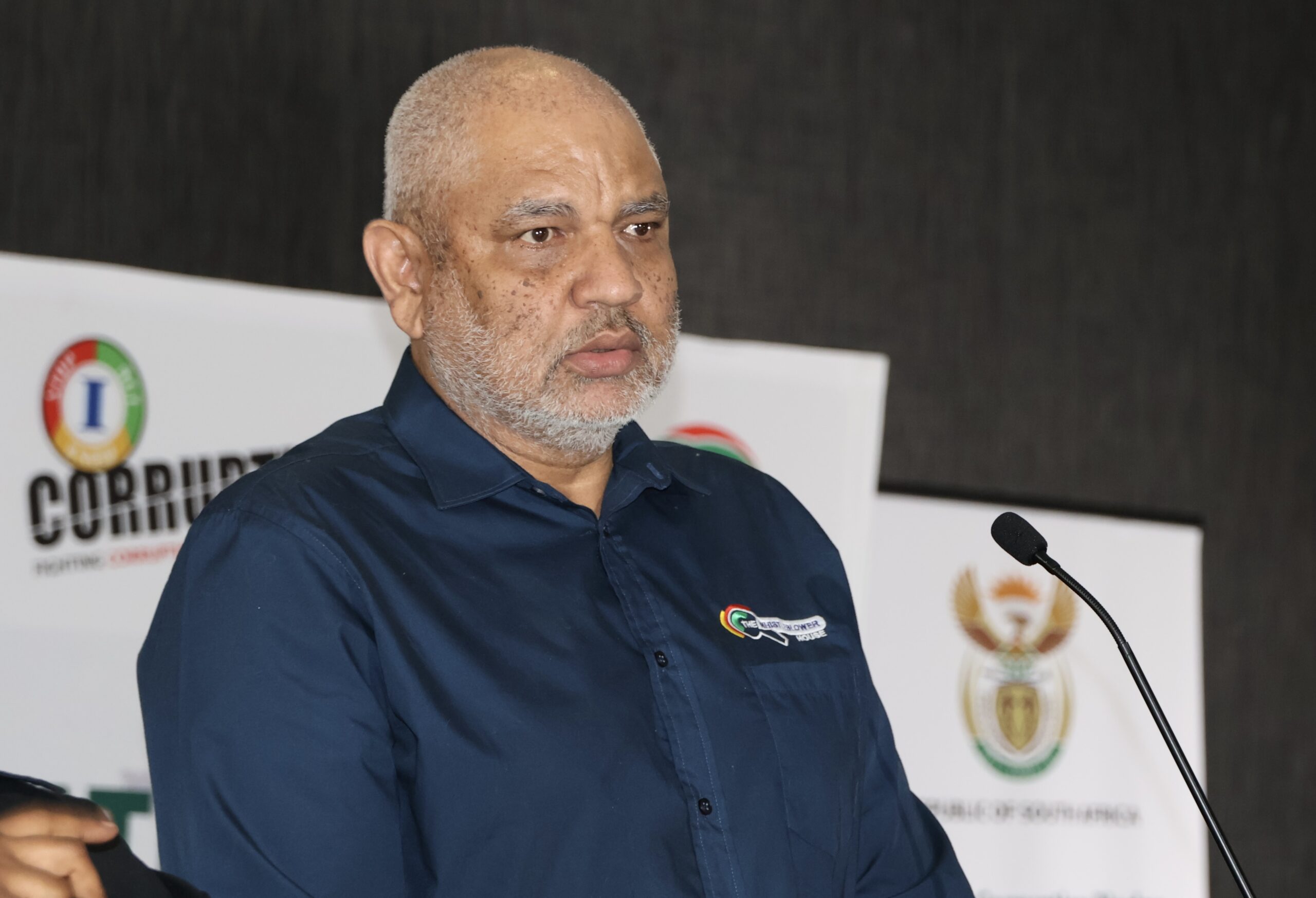
At the Department of Public Service and Administration’s International Anti-Corruption Day event, it wasn’t statistics or slogans that held the audience’s attention—it was the case studies. When Mr Ben Theron, CEO of The Whistleblower House (TWBH), took the podium, he spoke not only about corruption, but about the people who risk everything to expose it.
He began by redefining a term that is often misused: whistleblower. Not a saboteur. Not a disgruntled employee. A whistleblower, Mr Theron explained, is someone who reports wrongdoing in good faith because they believe someone must take action. It is an act rooted in integrity, not personal gain. Over the past three years, The Whistleblower House has quietly supported 434 such individuals—ordinary South Africans from government departments, state-owned entities, law enforcement agencies, private companies, and nonprofit organisations. Despite operating with only four staff members and limited publicity, TWBH has become a refuge for people who find themselves at the centre of storms they never sought to create.
Many of these individuals arrive frightened and overwhelmed. Nearly 88% need legal support because they suddenly face disciplinary charges, legal threats, or attempts to silence them. Almost half need psychological counselling due to the stress and retaliation that often follow their disclosures. And because court dates stretch years into the future, many remain in limbo, unsure of their futures and increasingly vulnerable to further hardship. Mr Theron emphasised that whistleblowers seldom receive the protection they are legally entitled to. Instead of being safeguarded, they are isolated, suspended, dismissed, or labelled as troublemakers. Few lawyers understand whistleblower legislation thoroughly enough to navigate these complex cases, and the systems designed to assist them—such as the CCMA—are not always adequately equipped or informed.
As Mr Theron shifted to the economic impact of whistleblowing, the scale became clear. He highlighted several whistleblowers whose interventions prevented or revealed staggering financial losses. At Daybreak Farms, an issue initially flagged at R15 million was revealed to have resulted in losses of R1.5 billion. At SAA, exposing irregularities around the Emirates deal helped avert an estimated R15 billion loss. And most painfully, Mr Theron spoke of Babita Deokaran, who uncovered R800 million in irregular transactions at Tembisa Hospital—long before the SIU confirmed that losses were closer to R2 billion. These were not anonymous numbers on balance sheets. They were examples of how whistleblowers safeguard public funds, protect communities, and uphold democratic values.
Yet behind every victory is a human cost. Mr Theron spoke of whistleblowers who endure intimidation, defamation, legal harassment, job loss, and, in the most tragic cases, threats to their safety. He reminded the audience that these individuals are parents, colleagues, neighbours—people like security professional Marius van der Merwe and public servant Babita Deokaran, whose bravery came at unimaginable personal sacrifice.
Despite the challenges, Mr Theron’s message carried a sense of hope and determination. The Whistleblower House is preparing for a strong advocacy push in 2026, proposing specialised whistleblower courts, targeted training for judges, cross-sector partnerships, greater public awareness campaigns, and research-driven legislative reform. Their goal is to shift South Africa’s culture from one that fears whistleblowers to one that celebrates them.
Mr Theron urged organisations to create environments where raising concerns is safe and encouraged. He reminded leaders that when employees speak up, it strengthens—not threatens—the organisation. And he called on all South Africans to recognise their own power. A single voice, he said, may seem small, but it can alter the direction of a company, a community, or even a country.
To support those who need guidance, TWBH has created four free whistleblower guidebooks—covering legal, financial, psychological, and security considerations—available on their website. They are also producing vodcasts to walk whistleblowers through each step of their journey.
As the event ended, the message lingered: Whistleblowers are not merely reporting misconduct—they are defending South Africa’s future. The Whistleblower House, sustained entirely by donations, stands as a lifeline for these individuals. And on this International Anti-Corruption Day, the organisation reminded the nation that courage is not just an act—it is a necessity. Protecting those who speak out is not optional; it is essential to the country’s integrity, accountability, and democratic resilience.