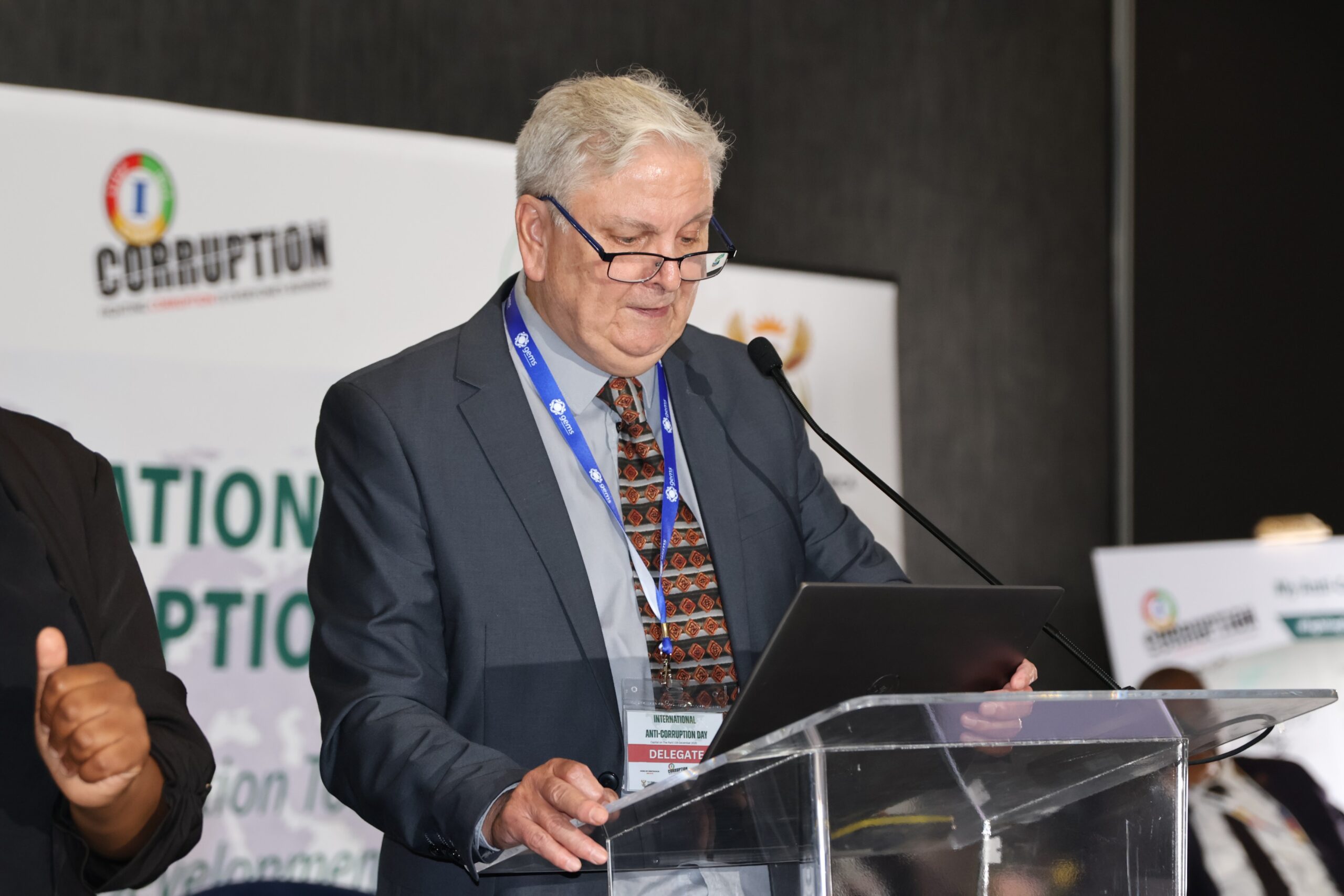
South Africa’s 2025 International Anti-Corruption Day, hosted by the Department of Public Service and Administration (DPSA) in Sandton on 9 December, brought together government, institutions, and oversight bodies to reflect on the country’s collective progress in building ethical, capable governance. Representing the Public Protector of South Africa, Advocate Neels van der Merwe commended ongoing efforts across all spheres of government and highlighted key interventions that can further strengthen local governance, service delivery and public trust.
Adv Van der Merwe noted that local government plays a uniquely important role because it is where communities interact most directly with the state. He emphasised that many municipalities are already working hard to stabilise leadership, tighten internal controls, improve financial management and deliver essential services under challenging circumstances. He said the Public Protector’s Office remains committed to working collaboratively with municipal leaders and government departments to support these efforts.
He explained that the Public Protector’s constitutional mandate, which extends across nearly 1,000 organs of state, enables the institution to identify patterns and emerging risks early and recommend solutions that help strengthen systems before failures occur. He highlighted that citizens’ complaints about water supply, roads, billing, housing and other essential services often point to broader opportunities for improvement within governance and administrative processes.
Rather than focusing solely on shortcomings, Adv Van der Merwe emphasised that addressing these challenges presents an opportunity to enhance ethical leadership, reinforce professional standards and improve how municipalities serve communities. He encouraged government departments, municipalities, and oversight bodies to continue promoting stability in senior management, strengthening infrastructure planning, improving records management, and ensuring the consistent implementation of internal controls.
He also welcomed the progress made in enforcing the Public Protector’s remedial actions. Compliance has risen significantly in recent years, from a historical 2% to 39%, and the institution is working closely with government partners to reach its 50% target in the next financial year. Initiatives such as Project CARA, funded through the Criminal Asset Recovery Account, are further enhancing the Public Protector’s ability to support municipalities through expert-informed investigations in areas like infrastructure, procurement and financial management.
Looking forward, Adv. Van der Merwe encouraged municipalities to draw on the Code for Ethical Leadership in Local Government, which outlines practical principles that help create stable, transparent, and community-centred administrations. These include ensuring merit-based appointments, cultivating strong oversight structures, engaging the public meaningfully, and consistently applying rules that safeguard integrity.
He noted that many municipalities are already demonstrating commitment to these principles and encouraged others to continue strengthening their governance environments. Ethical leadership, he said, is not only a legal requirement but a critical enabler of service delivery, community well-being and long-term development.
Adv Van der Merwe emphasised that the Public Protector’s Office sees itself as a partner to local government, not an adversary. He said that South Africa has the institutions, the legislative framework and the collective will to improve. By working together, strengthening cooperation across spheres, and ensuring early identification and prevention of risks, the country can ensure that local government continues to evolve into a centre of excellence in service delivery and public accountability.
“South Africa’s democracy has proven resilient, and with continued collaboration, ethical governance can become the foundation for a capable, developmental state that delivers a better life for all,” Adv Van der Merwe said.