
Ethics is everyone’s business, and not just the business of the ethics office. In most cases, the ethics office is a small unit with very little capacity, or ethics functions are implemented by people who have other responsibilities to take care of as well. There is a range of other role-players in an organisation who can support the ethics office. In this section, we look at the role of ethics ambassadors and ethics enablers.
Some organisations choose to designate ethics ambassadors in their different divisions or regions.
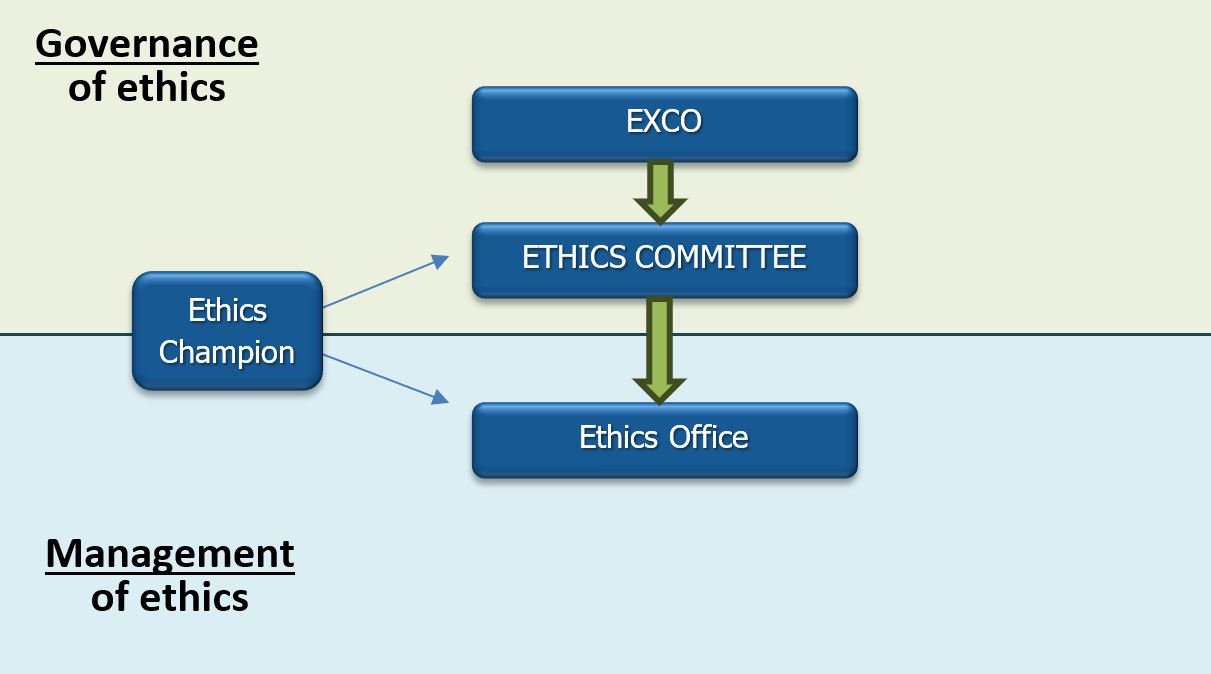
Ethics ambassadors are often described as “the hands and feet of the ethics office”. Their primary role is to be the ‘go-to’ person regarding ethics in their particular division, region, department, cluster or section of the organisation. In many cases the ethics office is small and does not have the capacity to disseminate ethics messages across the organisation, or to get a sense of the ethics issues in the departments across the organisation. The ethics ambassadors are advocates for the ethics office in their departments. They can spread messages or information from the ethics office to their units and can also then report back to the ethics office regarding ethics issues and concerns arising within their departments.
Source: The Ethics Institute
Ethics ambassadors are staff or people within different levels of the organisation who support the ethics office in addition to their regular jobs. Ethics ambassadors are not dedicated ethics staff; rather, they are informal promoters, advocates and guardians of the ethics in their particular division, region, department, cluster or section of the organisation. Ethics ambassadors support the ethics management function and report to it.
Ethics ambassadors are generally nominated by their peers or their supervisors. Depending on the size of the organisation, there could be a number of ethics ambassadors appointed to assume their roles across the different divisions in an organisation.
Additional Resource
The Ethics Institute’s Ethics Ambassador Handbook provides guidance to organisations on how to set up an ethics ambassador programme.
An ethics office cannot exist on its own. Building an ethical culture is a collective responsibility of all units across the organisation. The ethics office needs active support from other functions to achieve its mandate. As such, it is important that the ethics officer builds relationships with all units across the organisation and ensures that everyone understands the role and mandate of the ethics office and how it can be supported.
Enabling partners is the term used to describe those units in the organisation who can contribute special skills and perform highly specific roles in the process of managing ethics. They act as a support partner for the ethics office.
Ethics enablers are therefore internal support functions who collaborate with the ethics office to:
- Build core ethics into key HR, procurement, compliance, and training programmes or initiatives
- Monitor ethics performance in their functions and report on progress
- Help identify and manage ethics‑related risk in their functions.
The following table from the TEI Ethics Office Handbook sets out some of the functions which typically enable the ethics function and their interface with the ethics office:
| Function | Interface with the ethics office |
|---|---|
| Company secretariat |
|
| Risk management |
|
| Internal audit |
|
| Forensics |
|
| Legal |
|
| Compliance |
|
| Corporate communication |
|
| Human resource management |
|
| Employment relations |
|
Ethics enablers can actively support the ethics function through conversations and joint planning. The ethics strategy and implementation plan are opportunities for the ethics offices and enabling functions to co-create how they can work together to implement ethics initiatives in the organisation.

Strategic Work
Strategic work is done once in 3 years. This work integrates ethics into the organisation’s long-term vision, governance systems, decision making, and stakeholder engagement.

Institutionalisation
Everyday Work
The institutionalisation of ethics is the core role of the ethics officer or the everyday work. The focus of institutionalisation is on how to make ethics real in the organisation so that it becomes part of the organisational culture.
INSTITUTIONALISATION
Making Ethics RealIn The Organisation.
The work of the ethics officer is to manage the ethics programme of the organisation.