
“Leadership commitment to ethics is the single most influential driver of ethical culture. Where leadership actively supports and models ethical behaviour, the ethical culture strengthens. Where leadership is indifferent or inconsistent, the culture deteriorates.”
— Ethical Culture Handbook, The Ethics Institute (2022)
The Governance of Ethics Framework, as explained above, shows us the contributions of a range of role-players who collectively contribute towards building an ethical culture in an organisation.
The first dimension of the Governance of Ethics Framework is ‘Leadership commitment’. This means that leaders at all levels of an organisation need to show personal commitment to the ethical standards of that particular organisation.
Principle 1 of the King IV Code provides that “The governing body should lead ethically and effectively”. This principle emphasises the critical role of the governing body as the topmost leadership structure of the organisation to set the tone for ethics in the organisation and to lead both ethically and effectively.
| Does King IV apply to the public sector?
The King report is a voluntary and aspirational code of good corporate governance practices that organisations in South Africa are encouraged to follow. The practice recommendations are based on both international best practice and the local South African context. King IV is the latest iteration of the King reports. King IV sets out the role and responsibilities of governing bodies and the standard of conduct expected of governing body members. King IV can be applied to all organisations incorporated in South Africa irrespective of the nature and size, or the industry and sector in which the organisation operates. |
King IV provides that governing body members should cultivate and display the following characteristics in their conduct as leaders: Integrity, Competence, Responsibility, Accountability, Fairness and Transparency, commonly known as the ICRAFT Principles.
It is virtually impossible for any organisation to commence an ethics journey without its leaders being committed to building an ethical culture in the organisation. This commitment needs to trickle down from the governing body to all levels of leadership within the organisation.
What is leadership commitment?
Leadership commitment involves:
- Setting the ethical tone at the top – leaders must actively promote the institution’s values and code of ethics in their behaviour and decisions.
- Recognising the strategic importance of ethics and providing the ethics function with support and legitimacy.
- Supporting the ethics function by allocating resources, such as budget and personnel, to fulfil its role.
- Integration into governance structures – ensuring that ethics is embedded in the strategic objectives, policies, and oversight committees.
- Role modelling – leaders must embody ethical behaviour in their conduct and decision-making, reinforcing ‘ethics first’ over personal or institutional gain.
Source: TEI’s Ethics Office Handbook
Additional Resource
TEI’s Ethical Leadership Handbook is a useful resource which provides further guidance on the roles and responsibilities of leaders in achieving the outcome of an ethical organisational culture.
What does leadership commitment in the public sector mean?
Section 195 of the Constitution sets out that the public administration must be governed by the democratic values and principles enshrined in the Constitution, including, first and foremost that a high standard of professional ethics must be promoted and maintained.
The role of leadership in the public administration is to set the tone for ethics by being ethical and creating an environment that supports the building of an ethical culture.
Who is leadership in the public sector?
In the public sector, leadership is represented at both the political and administrative levels.
At a political level, the topmost leadership position in a public service department would be the political head.
The Public Service Act, 1994 as amended, refers to the political head of a public service department as the Executive Authority and explains that in the case of a national department, the Executive Authority would be the Minister. In the case of a provincial department, the Executive Authority would be the MEC (Member of Executive Council).
Section 3 of the Public Service Act, 1994 sets out the functions of an Executive Authority and explains that the Executive Authority is responsible for the internal organisation of a public service department, including its organisational structure and establishment and the career incidents of employees of the department.
The Executive Authority steers the political direction of the department, and outcomes which the department must achieve to deliver on its mandate.
The administrative head of a department is the Head of Department.
The role of the Head of Department is to implement the policy set by the Executive Authority and achieve the outcomes which have been set. The Head of Department has to do this by ensuring the delivery of the outputs that have been set out or defined in the departmental budget.
Simply put, the Executive Authority determines the political direction of the department, and the Head of Department then ensures the delivery or implementation of this direction within the budget that has been set or defined for the department.
With respect to ethics management, regulation 22 of the Public Service Regulations as amended provides that the Head of Department is responsible for ethics management in the department.
Public Service Regulations – Part 3 – Anticorruption and ethics management
22. A Head of Department shall—
- establish a system that encourages and allows employees and citizens to report allegations of corruption and other unethical conduct, and such system shall provide for—
- confidentiality of reporting;
- the recording of all allegations of corruption and unethical conduct received through the system; and
- mechanisms to ensure that employees and citizens are made aware of such system;
- establish an information system that—
- records all allegations of corruption and unethical conduct;
- monitors the management of the allegations of corruption and unethical conduct;
- identifies any systemic weaknesses and recurring risks;
- maintains records of the outcomes of the allegations of corruption and unethical conduct; and
- records all gifts accepted by employees as contemplated in regulation 13 (h); and
- refer allegations of corruption to the relevant law enforcement agency and investigate whether disciplinary steps must be taken against any employee of the department and if so, institute such disciplinary action.
In the public service, the political leadership (i.e., the Executive Authority/Minister/MEC) is responsible for the strategic leadership and direction of the organisation, and the administrative leadership is responsible for driving and implementing the ethics programme. Building an ethical and professional public service requires ethical leaders at both political and administrative levels.
In local government, a municipal council represents the topmost level of political leadership. Section 157 of the Constitution sets out that a municipal council consists of elected members.
Section 11 of the Municipal Systems Act, 2000 then sets out that the executive and legislative authority of a municipality are exercised by council. This means that the council develops the strategic direction for the municipality, sets up its administration and steers the political direction for the municipality.
Section 19 of the Municipal Structures Act, 1998 sets out that the municipal council must ensure that the municipality achieves the objectives of local government as set out in section 152 of the Constitution, which are:
- to provide democratic and accountable government for local communities;
- to ensure the provision of services to communities in a sustainable manner;
- to promote social and economic development;
- to promote a safe and healthy environment; and
- to encourage the involvement of communities and community organisations in the matters of local government.
The municipal council is considered the governing body of a municipality. Although the municipality is headed by the Mayor, the municipal council is chaired by the Speaker. Both the Mayor and the Speaker have the responsibility to set the tone for Council.
Council is responsible for setting the strategic direction of the municipality, approving municipal policies, exercising oversight and disclosing on how the strategic direction of the municipality has been achieved.
The municipal manager is the administrative head of the organisation and is responsible for setting the tone for an ethical culture within the municipality. The municipal manager, with support from the executive team, would be responsible for implementing the strategic direction on ethics as provided by Council.
Municipal Integrity Management Framework
Principle One: Leadership Commitment
Municipal leadership should set the tone and drive good governance, organisational integrity, and anti-corruption initiatives.
Councillor responsibilities
Councillors should set an ethical tone for the municipality, ensuring sound governance and strong oversight in the interest of the community.
Accounting Officer responsibilities
The Accounting Officer should:
- provide ethical leadership to the administration of the municipality;
- ensure that the municipality has a strong programme in place to promote both integrity and fight corruption; and
- allocate sufficient resources for the implementation of the integrity management requirements.
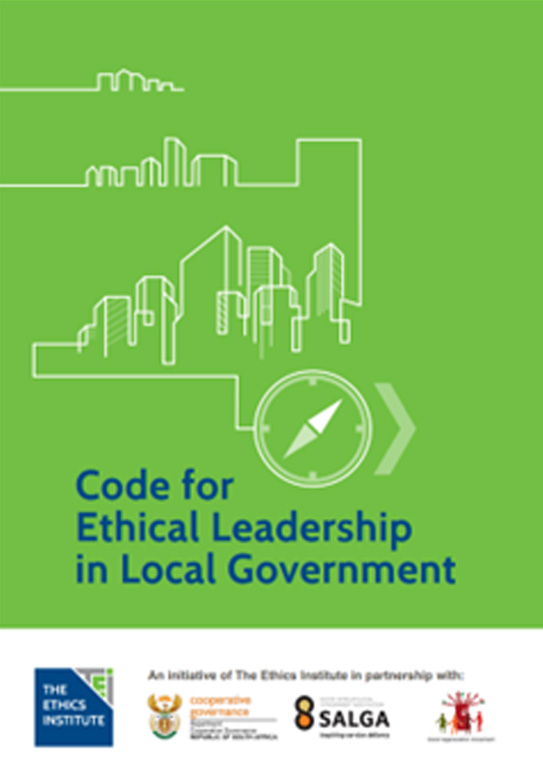
Additional Resource
Code for Ethical Leadership in Local Government
For the effective running of a municipality, it requires that the political and administrative leadership work together and lead ethically to support the building of an ethical culture in the municipality.
However, the political–administrative interface in local government can be challenging. The research conducted as part of the Local Government Ethical Leadership Initiative identified the challenges around ethical leadership in local government.
Based on the findings from this research, the Code for Ethical Leadership in Local Government was then developed to give guidance to local government leaders on how to navigate those issues that have the biggest impact on ethical governance in municipalities based on the research. The Code emphasises that ethical leadership is an absolute prerequisite for successful developmental local government as envisaged by the Constitution.

Strategic Work
Strategic work is done once in 3 years. This work integrates ethics into the organisation’s long-term vision, governance systems, decision making, and stakeholder engagement.

Institutionalisation
Everyday Work
The institutionalisation of ethics is the core role of the ethics officer or the everyday work. The focus of institutionalisation is on how to make ethics real in the organisation so that it becomes part of the organisational culture.
INSTITUTIONALISATION
Making Ethics RealIn The Organisation.
The work of the ethics officer is to manage the ethics programme of the organisation.