
The Governance of Ethics Framework as developed by The Ethics Institute provides a structured approach for organisations to proactively work towards the outcome of building an ethical culture.
This Framework sits in the heart of the thinking of King V when it refers to the outcome of an ethical culture. It also reflects the thinking of the Public Service Regulations, 2016 and the Municipal Integrity Management Framework when these envisage organisations working towards the outcome of an ethical culture.
See the links further down on this page to navigate to the sections that you are interested in.
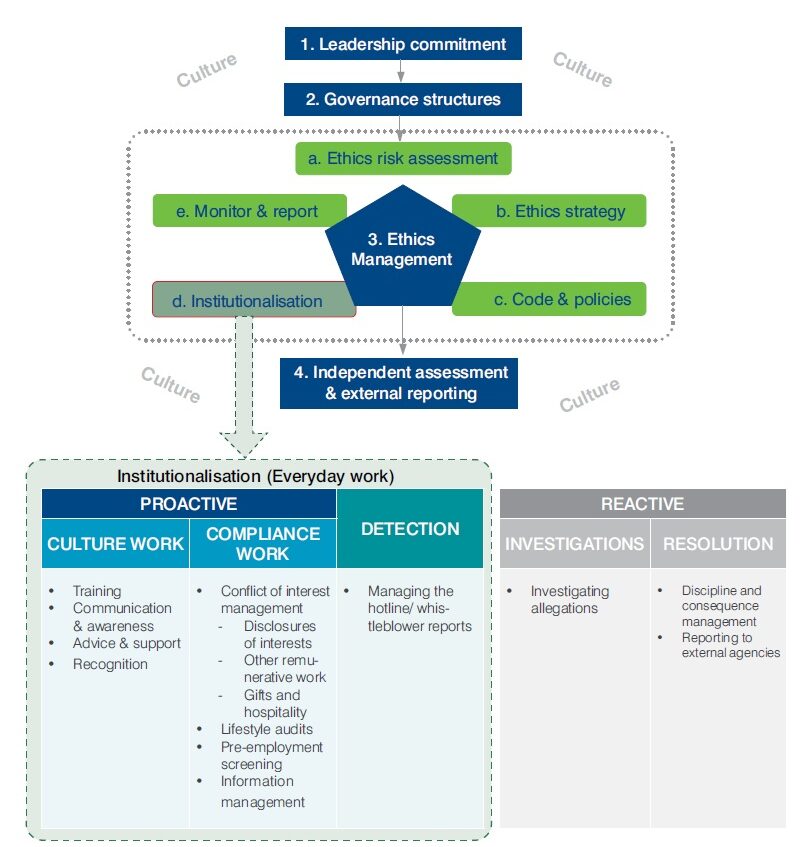
The Framework provides a practical roadmap which sets out how organisational role-players at both the governance and management level in an organisation can work together to support the building of an ethical culture.
- The first and most important component of the framework is strong leadership commitment that sets a clear ethical tone. Leadership should also establish ethics structures (such as an ethics office) and assign responsibilities for managing ethics (for example, to an ethics champion and an ethics officer).
- Second, there needs to be appropriate governance structures (such as an ethics committee) in place to exercise oversight over the ethics management in the organisation to support the organisation towards the outcome of an ethical culture. This is called the Governance of Ethics.
- Thirdly, the ethics capacity that has been put in place needs to implement the following ethics management process. This is called the Management of Ethics.
- Ethics risk assessment: An ethics risk and opportunity assessment should be conducted to ensure that the department understands its ethics risk profile.
- Strategy: A strategy and plan for managing ethics in the organisation must then be formulated.
- Code and policies: The departmental code of ethics (or values statement), and other relevant policies must be developed, or revised, to ensure that the identified risks are addressed.
- Institutionalisation: The ethics management strategy and plan must be implemented to ensure that everyone in the department consistently acts in line with the departmental values and standards. (This makes up the day-to-day work of the ethics office, and therefore has its own section.)
- Monitoring and reporting: The ethics officer should report to the ethics committee on progress with the ethics management plan, and the state of ethics in the organisation.
- Fourthly, there should be independent assessment of the ethics management processes (for example, by internal audit) and of the ethics management reports (for example, by external auditors). This should then be reported to external stakeholders in the appropriate reports, such as annual reports.
The end goal is the establishment of an ethical culture that supports a professional public service ethos and high standards of integrity in the department.
How to usethe Guide.
The guide attempts to follow a simple and understandable approach that makes things as practical as possible. It covers the basics that every ethics officer should know – such as what laws and regulations apply to the work of ethics officers – but also goes into further detail on what to consider when doing the work. It includes checklists and additional resources that can be consulted to obtain a broader understanding.
You can use the guide in one of two ways. The first option is to read it like a book, starting at the front and working to the back.
The second option is to read about specific challenges that you are struggling with. For example: if you need to facilitate ethics training, but don’t know where to start – click on the section that deals with training and see if there are resources to help you. If you are struggling with the disclosure of financial interests process, or dealing with conflicts of interest, go directly to that section.

Strategic Work
Strategic work is done once in 3 years. This work integrates ethics into the organisation’s long-term vision, governance systems, decision making, and stakeholder engagement.

Institutionalisation
Everyday Work
The institutionalisation of ethics is the core role of the ethics officer or the everyday work. The focus of institutionalisation is on how to make ethics real in the organisation so that it becomes part of the organisational culture.
INSTITUTIONALISATION
Making Ethics RealIn The Organisation.
The work of the ethics officer is to manage the ethics programme of the organisation.