
While the overall purpose of the ethics programme is to build an ethical culture, there are some aspects of an ethics officer’s job that are carried out to comply with specific regulations and requirements.
As set out earlier, any organisation should implement internal controls to manage its risks and ensure good governance. The internal control environment consists of hard controls and soft controls. The hard controls are the policies and procedures, and the soft control environment consists of the ethical culture of the organisation.
In this section the focus is on the hard control environment – or the compliance work.
We will divide this into:
- Conflict of interest management
- Disclosures of interests
- Other remunerative work
- Gifts and hospitality
- Lifestyle audits
| “Conflict of interest: A situation where an individual is confronted with choosing between the requirements of his/her official function and his/her own private interests.”
– Global Reporting Initiative |
There is generally a link between conflicts of interest and corruption. A conflict of interest could potentially cause me to abuse my entrusted power for private gain. In other words, if I don’t manage my conflict of interest I may be acting corruptly.
Some people also purposefully exploit situations to create conflicts of interest with the sole purpose of acting corruptly.
For this reason, managing conflicts of interest is clearly linked to preventing corruption, and can be a fairly large part of an ethics officer’s job.
Useful Resource
The Ethics Institute released the Conflict of Interest Handbook.
This handbook is practically written specifically for ethics officers. It is divided into three sections:
1. Understanding conflicts of interest
This section provides definitions and a vocabulary for discussing different types of conflicts of interest. It also explains the legislative and regulatory environment for dealing with conflicts of interest.
2. Managing conflicts of interest
This section provides guidance on how to manage conflicts of interest in organisations. It covers policies, procedures, and systems for managing conflicts of interest.
3. Making conflict of interest decisions
This section considers the thinking process of evaluating individual conflict of interest situations. It might be useful to both ethics officers and employees.
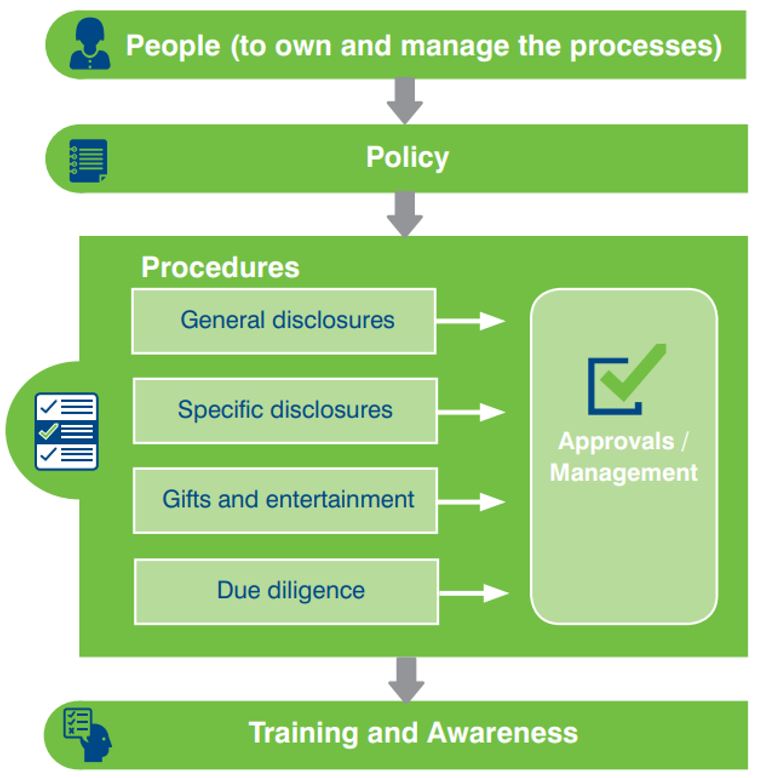
The Ethics Institute’s Conflict of Interest Handbook sets out the following framework for managing conflicts of interest in organisations.
Source: TEI Conflict of Interest Handbook
-
- To start with, there should be people (i.e., staff members) to manage conflicts of interest. In the public sector this responsibility frequently falls on ethics officers.
- A suitable policy should be developed. This policy should set out the organisation’s stance on conflicts of interest. It should ideally be principle-based, and should give examples of what is acceptable and what is not. In the public sector the policy must align with the relevant legislation, which we will clarify below.
- Procedures should be put in place to give effect to the policy. The procedures should include means for making potential conflicts transparent, including through:
- General disclosures of interest. These are the financial disclosures that are made whether or not there is a conflict of interest. You are just required to generally disclose your interests on an annual basis. In the public service this is done through the eDisclosure system.
- Specific disclosures of interest. These are disclosures that people make throughout the year whenever they face a conflict of interest. This might, for example, be where I am in a bid committee meeting and realise that my brother’s company is tendering. I will then have to say something and recuse myself. Or when I need to apply for other remunerative work.
- Disclosure of gifts and entertainment. These must be disclosed on an ad hoc basis in line with the gift policy.
- Due diligence procedures. This is a process by which one checks whether one’s service providers have conflicts of interest with staff members or their families.
Once interests are transparent, they should be either approved, or actively managed. It must be emphasised that the disclosure of a conflict does not make the conflict disappear. Once it is disclosed, it must still be dealt with responsibly. Disclosure is just the first step.
- Lastly, one should consider a training and awareness approach to influence the organisational culture on conflicts of interest.
Download the extract from the TEI Conflict of Interest Handbook related to public sector officials. The handbook contains a separate section on politicians.
Public Service
- Code of Conduct for Public Service Employees
- Public Service Regulations – Chapter 2, Part 2 – Financial Disclosure
- Directive on other categories of employees designated to disclose their financial interests (2021)
- Directive on other remunerative work outside the employee's employment in the relevant department (2024)
- Directive on conducting business with an organ of state (2024)
Local Government
Public Service
- Guide on the prevention and management of conflicts of interest in the public service (DPSA, 2023)
- Guide on managing other remunerative work in the public service (DPSA, 2025)
- Guide and procedures on managing conducting business with an organ of the state (DPSA)
- Guide on Managing Gifts in the Public Service (DPSA, 2019)
- Guide to implement lifestyle audits in the Public Service (DPSA, 2021)
- Explanatory manual – My guide to completing the financial interests disclosure form (DPSA)
For further guidance on the details of managing conflicts of interest, please download the section on ‘What should ethics officers do?’
It sets out exactly what ethics officers should do in relation to conflict of interest management, and deals with:
- Developing a policy on conflicts of interest
- Disclosure of financial interests
- Other remunerative work
- Gifts and hospitality
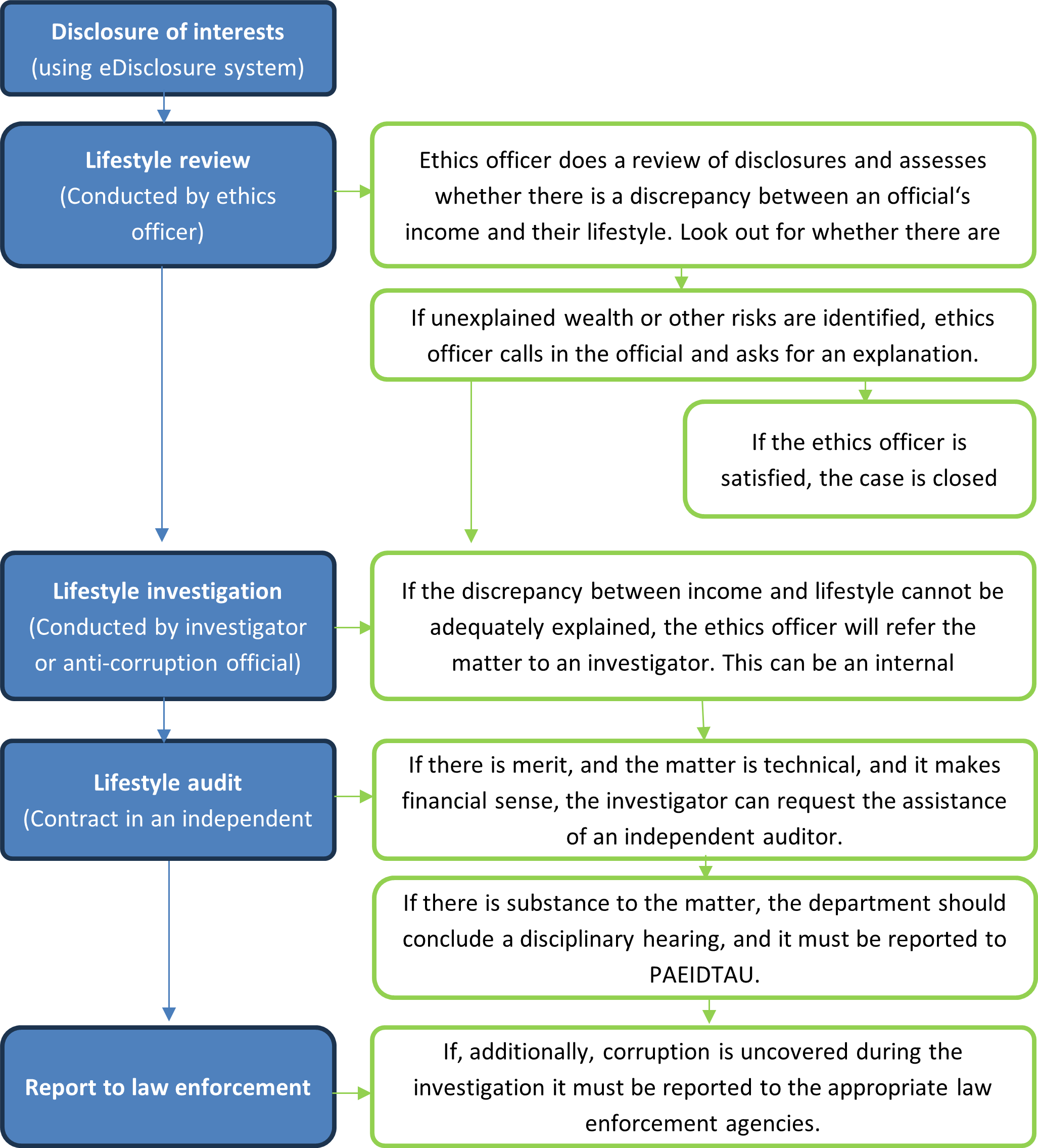
Lifestyle reviews (also sometimes called lifestyle audits) are an extension of the disclosure of interest process.
After the disclosure process, it is possible to check if there are discrepancies between people’s assets and their income. This can be based on the disclosure, or it can be due to reports raised by other employees.
Guidance
Guide to implement lifestyle audits in the Public Service (2021)
| Compliance requirements | |
| Public Service Regulations – Chapter 2, Part 2 – Financial Disclosure | |
| Lifestyle reviews | |
| Conduct a risk analysis on disclosed interests and income of all disclosures. (See Guide to implement lifestyle audits in the Public Service for more detail on how to do this.) | |
| Consult employees for explanations where discrepancies exist. | |
| Investigate whether disciplinary action must be taken where explanations do not sufficiently explain discrepancies AND institute disciplinary action. | |
| Refer to law enforcement agencies on suspicion of a criminal offence. |
Schematic representation of the ‘lifestyle audit’ process in the public service.
There is currently no requirement for lifestyle audits in local government.
When appointing new staff into the organisation we want to ensure they are people of integrity and competence. They must be able to do the job well, and must be ethical.
While job-specific assessments can be carried out for competence, it is very difficult to test for the trait of integrity. This means that the best we can frequently do is to try to ensure that we don’t get bad apples coming into the organisation. This is done through pre-employment screening.
This is generally performed by the HR function, although some ethics functions have been assigned this task.
What should be verified during a pre-employment screening?
| Resource: Directive on Human Resources Management and Development for Public Service Professionalisation (DPSA, 2024)See specifically section 1.37 to 1.41, which deals with personnel suitability checks. |
1.38 The personnel suitability checks contemplated in Regulation 57(1)(c) of the Regulations shall consist of the following:
1.38.1 Criminal record checks;
1.38.2 Citizenship or Permanent Residency verification;
1.38.3 Financial record checks;
1.38.4 Qualification/ Study verification;
- a) The verification of a national senior certificate is not a requirement, where a national senior certificate is not the minimum inherent requirement of the post.
- b) Departments may verify qualifications using verified academic records where applicants do not possess certificates.
1.38.5 Registration with professional bodies where it is part of the inherent requirements of the post;
1.38.6 Verification of any dismissal for misconduct; and
1.38.7 The qualifications of selected candidates for a Deputy Director-General post shall be verified by the South African Qualifications Authority to determine the NQF level and validity.
Departments frequently use external service providers to conduct these checks on their behalf. If you don’t have access to this, verifications can be done as follows:
| What to check | Where to check |
| Criminal record check | SAPS |
| Citizenship or Permanent Residency verification | Home Affairs |
| Financial / asset record checks | State Security Agency |
| Qualifications/study verification | SAQA / Institution where study was completed |
| Previous employment (Reference checks) | Applicant will give references whom you can contact. You can also write to / call the previous employer. |
| Registration with professional bodies (if required) | With the relevant professional body |
| Verification of any dismissal for misconduct | Central register for verification of dismissals and resignations pending disciplinary case https://www.dpsa.gov.za/resource_centre/peverification1/ |
Remember that as part of the application process, the applicant needs to consent to background checks.
While pre-employment checks are only required on appointing new candidates, it is good practice to also do checks when promoting candidates.
These pre-employment checks must be conducted separate from the vetting process, which only takes place after employees have been appointed, and is only for certain positions.
Extract from the Municipal Integrity Management Framework
4.5. Pre-employment screening
- Municipalities must ensure that competent employees with high standards of personal integrity are appointed and promoted.
- Senior manager appointments must comply with the minimum competency requirements as set out in the Regulations on appointment and conditions of employment of senior managers (Municipal System Act: Regulations on appointment and conditions of employment of senior managers – Annexure B)Roles of other parties:
- DCoG should verify compliance with competency requirements.
- DCoG should develop a national competency testing centre for senior managers.
- Pre-employment screening should be conducted for all new appointments to verify:
- Qualifications
- Previous employment
- Disciplinary record
- Criminal record
- Any outstanding investigations or disciplinary matters at previous employers
Relevant legislation: Municipal Systems Act – s.57A
(1) Any staff member dismissed for misconduct may only be re-employed in any municipality after the expiry of a prescribed period. Relevant periods are set out in the ‘Regulations on appointment and conditions of employment of senior managers: schedule 2’
(2) The Minister must maintain a record of all staff members that have:- Been dismissed for misconduct or
- Resigned prior to the finalisation of the disciplinary proceedings which record must be made available to municipalities as prescribed.
- Municipalities must consult the record on dismissed employees kept by the Minister and must abide by the prescribed periods.
- Employees should be re-screened when they are promoted, especially if different levels of qualifications are required by the new position.
- Municipalities should conduct a once off qualifications audit on senior managers and other officials key positions.
Managing information on the work of the ethics office should not be left as an afterthought – it is an integral part of the work. Information management is important for structuring your work, and helps you keep track of disclosures of interest, gifts, and training stats. It is also essential for compiling reports to the ethics committee or management.
What is an information management system?
It is simply a way to manage information related to a specific topic. The simplest and most widely used information management systems are spreadsheets. Most people use a system such as Excel to keep their information safe and structured. More advanced systems would be databases that are specifically designed to suit the purpose you want to use them for. For most departments a spreadsheet should be sufficient, but if you have the internal resources you may want to speak to your IT department about customising a solution for you.
While there is currently no official format for managing data, ethics officers should consider having information management systems for the following:
- Training statistics
- Dates of training sessions
- Number of people who participated
- Unit that participants are from
- Duration of training
- Topics covered
- Evaluation score of training session
- Disclosures of interest
- Who has disclosed
- When did they disclose
- Highlight disclosures that were flagged
- Highlight disclosures where lifestyle assessments were conducted
- Capture the outcome of the lifestyle assessment
- Lifestyle audits
- Number of lifestyle reviews launched
- Why was the lifestyle review launched (e.g., risk identified during the disclosure process, or report from a whistleblower)
- Number of lifestyle reviews referred for investigation
- Number of lifestyle audits passed/failed
- Gifts and hospitality
- Gifts disclosed
- Permission sought
- Permission granted / declined
- Gift value
- Gift giver
- Gift recipient
The above is just indicative of some examples, and a spreadsheet will contain much more information than this.
Another approach may be to keep a list of all employees in the department. You can then indicate which employees have:
- Acknowledged reading the Code of Conduct
- Disclosed their interests
- Been sent for a lifestyle audit
- Attended training
Case management system
Public Service Regulations – Part 3 – Anticorruption and ethics management
22. A Head of Department shall—
- establish an information system that—
- records all allegations of corruption and unethical conduct;
- monitors the management of the allegations of corruption and unethical conduct;
- identifies any systemic weaknesses and recurring risks;
- maintains records of the outcomes of the allegations of corruption and unethical conduct; and
- records all gifts accepted by employees as contemplated in regulation 13 (h).
The most important information management system that a department needs to keep is the case management system. This logs all cases reported or detected, and tracks their progress through investigation to resolution.
As a minimum, public service departments should keep data on the issues set out in Regulation 22 of the Public Service Regulations as shown above.
- Case management system
- Allegations of misconduct
- Type of misconduct
- Where reports were received from
- Organisational unit involved
- Who is the investigating officer?
- How long has the investigation been ongoing?
- What was the outcome of the investigation?
- How many allegations were referred to SAPS or other law enforcement agencies?
The data should periodically be assessed to see if any systemic weaknesses can be identified. For example, where one sees that the same type of issue occurs consistently, and that one might need to address this through specific interventions.
This will be further discussed in the section on whistleblowing.
| Compliance requirements
The following are some of the main compliance requirements related to information management. There is significant overlap with other sections of the document. |
|
| Public Service Regulations – Chapter 2, Part 3 – Anti-Corruption and Ethics Management | |
| (d) establish an information system that—
(i) records all allegations of corruption and unethical conduct; (ii) monitors the management of the allegations of corruption and unethical conduct; (iii) identifies any systemic weaknesses and recurring risks; (iv) maintains records of the outcomes of the allegations of corruption and unethical conduct; and
|
|
| (d) establish an information system that—
(v) records all gifts accepted by employees as contemplated in regulation 13 (h);
|
|
| Directive on other categories of employees designated to disclose their financial interests (2021) | |
| Keep a register of relevant employees’ interests (PSR 17(2)). | |
| Report to MPSA: Number of employees who failed to disclose, and steps taken against them. | |
| Report to MPSA: Number of employees found to have conflicts and consequent actions. | |
| Directive on conducting business with an organ of state (2024) | |
| Register kept of all entities that conduct business with the department. | |
| Register kept on all persons who are engaged in supply chain management on behalf of the department. | |
| Reports submitted to EA on the policy and registers. | |
| HoD reports contraventions to SAPS and Public Administration Ethics, Integrity and Disciplinary Technical Assistance Unit (PAEIDTAU). | |
| EA reports Annexure B to the MPSA through PAEIDTAU. | |
| Public Administration Management Act (2014) | |
| Issues of misconduct emanating from criminal investigations must be reported to PAEIDTAU and DG: DPSA. | |
| Issues of misconduct emanating from criminal investigations must be reported to the HoD for initiation and institution of disciplinary proceedings. | |
| The HoD must report to PAEIDTAU and DG: DPSA on disciplinary steps taken. |
Local Government
Extract from the Municipal Integrity Management Framework
5.3. Analysis of information / Data analytics
- Information should be analysed to detect possible conflicts of interest or other fraud or corruption red flags. This includes information obtained from:
- Disclosures of interests;
- External remunerative work applications;
- Gift registers;
- The municipal vendor database;
- Financial management system; and
- The Companies and Intellectual Property Commission (CIPC) database.
- Transactional information should also be analysed by using information technology to highlight red flags.
- Data analytics can be technical and municipalities should consider getting external expertise if it is not available in-house.
5.6. Data management
- Municipalities must establish a case management system that:
- Keep records of all reported cases and cases under investigation.
- Tracks progress
- Allows for trend analysis
- Aligns with the reporting requirements of national and provincial government.
Relevant regulation:
MFMA: Municipal regulations on financial misconduct procedures and criminal proceedings, 2014.
– Section 14 of the regulations require municipalities to prepare an information document on any alleged financial misconduct or offence stating:- Name and position of person alleged to be involved;
- Summary of facts.
- Monetary amount involved.
- Disciplinary steps taken or to be taken.
- If no disciplinary steps are taken, the reason for this decision.
- Case number issued by SAPS if it is a financial offence.
- Steps taken to recover unauthorized, irregular or fruitless and wasteful expenditure.
This information must be submitted to a number of entities. The information management system must therefore keep data at least on these aspects.
Section 34 of the Prevention and Combating of Corrupt Activities Act requires persons in positions of authority to report acts of corruption, or acts of fraud involving more than R100 000 to the SAPS. The information management system should keep proof of these reports.
- The information should be kept in electronic format.
- Steps should be taken to ensure that the information is secure and remains confidential in line with the Minimum Information Security Standards (MISS).
- Regular reports must be submitted to the Municipal Manager and the Audit Committee.
- Reports must also be submitted to external entities as set out in section 8 of this document.
The ethics office will at some point need to report information to other stakeholders. This will include the ethics committee (inside the organisation), as well as government structures outside the organisation.
Useful Resource
See The Ethics Institute’s Ethics Reporting and Auditing Handbook (2022).
This handbook contains a section on the monitoring of ethics programmes, and also the reporting that is done by the ethics office to the ethics committee. These sections of the handbook can be useful to ethics officers when it comes to the information management and reporting.
A good information management system is critical for ensuring that the information that is required is logged in time, and is accurate when it comes to reporting.
8. Reporting
Principle:
- Municipalities must submit reports to appropriate entities to ensure implementation and transparency.
- Effective information management systems should be implemented to ensure the appropriate information is kept and reported.
Implementation:
8.1. Reporting on implementation of the Framework
- Those responsible for implementing the Framework (i.e. integrity management practitioners) should report quarterly to the Municipal Public Accounts Committee (MPAC).
- A report must also be submitted to council.
- A report on integrity management and corruption response must also be made public on an annual basis.
8.2. Reporting of allegations and outcomes
(Internal reporting)
Municipal regulations on financial misconduct procedures and criminal proceedings, 2014.
These regulations require:
- The mayor or accounting officer to table an allegation of financial misconduct before the council not later than 7 days after receipt thereof or at the next sitting of the council.
Back to Basics Approach requires the following reporting:
- Speaker to report on a monthly basis to Council on:
- How many misconduct issues were brought to the attention of councillors and how these are being addressed.
- All actions being taken to address fraud and corruption.
- Municipal manager to report on a monthly basis to Council on:
- The overall operations of financial management and all reported instances of fraud and corruption, including actions being taken.
8.3. Reporting of allegations and outcomes
(External reporting)
MFMA: Municipal regulations on financial misconduct procedures and criminal proceedings, 2014.
These regulations stipulate:
- The responsibility of the accounting officer (or the council if the accounting officer is involved) to report alleged financial offences to the South African Police Service.
- This is also required by the MFMA s.32(6) and (7);
- That, when investigating a councillor, ‘the designated official’ must submit completed investigative reports to council and make it available to the public. In five days from submitting it to council the report must also be submitted to:
- MEC for finance in the province;
- MEC for local government in the province;
- Minister of Finance; and
- Minister responsible for local government.
- Municipalities must prepare an information document on any alleged financial misconduct or offence stating:
- Name and position of person alleged to be involved;
- Summary of facts
- Monetary amount involved
- Disciplinary steps taken or to be taken
- If no disciplinary steps are taken, the reason for this decision.
- Case number issued by SAPS if it is a financial offence
- Steps taken to recover unauthorized, irregular or fruitless and wasteful expenditure.
- This information should within 5 days of finalizing investigation documents be reported to:
- The mayor
- The MEC for local government in the province
- The national department responsible for local government
- The provincial treasury
- National Treasury; and
- Auditor General.
- This aligns with s.32(4) of the MFMA which requires all losses and consequent steps to be promptly be reported to the Auditor General and MEC for local government in the province.
- All suspensions, disciplinary and criminal proceedings for financial misconduct must be reported in municipalities’ annual reports.
Municipal Systems Act
- Section 57A of the act requires municipalities to report certain information on disciplinary proceedings to the MEC for local government, as set out below.
Relevant legislation:
Municipal Systems Act – s.57A
(6) A municipality must maintain a record that contains the prescribed information regarding the disciplinary proceedings of staff members dismissed for misconduct.
(7) A copy of the record referred to in subsection (6) must be submitted to the MEC for local government on a quarterly basis.
(8) The MEC for local government must, within 14 days of receipt of the record referred to in subsection (6), submit a copy thereof to the Minister.
(9) The Minister must maintain a record of all staff members that have-
(a) been dismissed for misconduct; or
(b) resigned prior to the finalisation of the disciplinary proceedings,
which record must be made available to municipalities as prescribed.

Strategic Work
Strategic work is done once in 3 years. This work integrates ethics into the organisation’s long-term vision, governance systems, decision making, and stakeholder engagement.

Institutionalisation
Everyday Work
The institutionalisation of ethics is the core role of the ethics officer or the everyday work. The focus of institutionalisation is on how to make ethics real in the organisation so that it becomes part of the organisational culture.
INSTITUTIONALISATION
Making Ethics RealIn The Organisation.
The work of the ethics officer is to manage the ethics programme of the organisation.