
This guide is written for all those doing the work of ethics officers in the public sector – including those in:
- The public service (national and provincial government), and
- Municipalities.
This includes those who are appointed as ethics officers, as well as those who fulfil other functions (such as risk management) and are designated as ethics officers. It is intended to be a practical guide to ethics management in the public sector.
It is compiled for those who have been appointed, or designated, the responsibility for managing ethics in their organisations. We generally (and throughout this guide) refer to these people as ethics officers.
The Public Service Regulations require all departments to appoint or designate ethics officers. The Municipal Integrity Management Framework that forms part of the 2016 Local Government Anti-Corruption Strategy similarly requires that there should be sufficient capacity to implement the integrity management requirements that are set out in the Framework.
You will be glad to know that in February 2024, the title of ‘Ethics Officer’ was incorporated into the Public Service Occupational Classification System: Occupational Dictionary, under the ‘Professionals’ category as follows:
This formal recognition further legitimises the role of the Ethics Officer. |
There are hundreds of ethics officers in public sector organisations. Some fulfil this function part time, besides their other responsibilities, while others are appointed as full-time ethics officers. There is, however, not a formal university qualification that ethics officers can follow to become qualified for the job. Ethics officers also have varied work experiences and are often simply ‘suddenly’ designated the responsibility with no prior experience.
The guide is therefore intended to equip ethics officers in the public sector to execute their duties with confidence through adequate knowledge of ethics management.
It provides a single resource which ethics officers can refer to for guidance and information on how to fulfil their roles. It includes critical information about the legislative obligations of ethics officers in the public sector as well as practical guidance on how to perform the day-to-day responsibilities.
The guide attempts to follow a simple and understandable approach that makes things as practical as possible. It covers the basics that every ethics officer should know – such as what laws and regulations apply to the work of ethics officers – but also goes into further detail on what to consider when doing the work. It includes checklists and additional resources that can be consulted to obtain a broader understanding.
You can use the guide in one of two ways. The first option is to read it like a book, starting at the front and working to the back.
The second option is to read about specific challenges that you are struggling with. For example: if you need to facilitate ethics training, but don’t know where to start – click on the section that deals with training and see if there are resources to help you. If you are struggling with the disclosure of financial interests process, or dealing with conflicts of interest, go directly to that section.
See the links further down on this page to navigate to the sections that you are interested in.
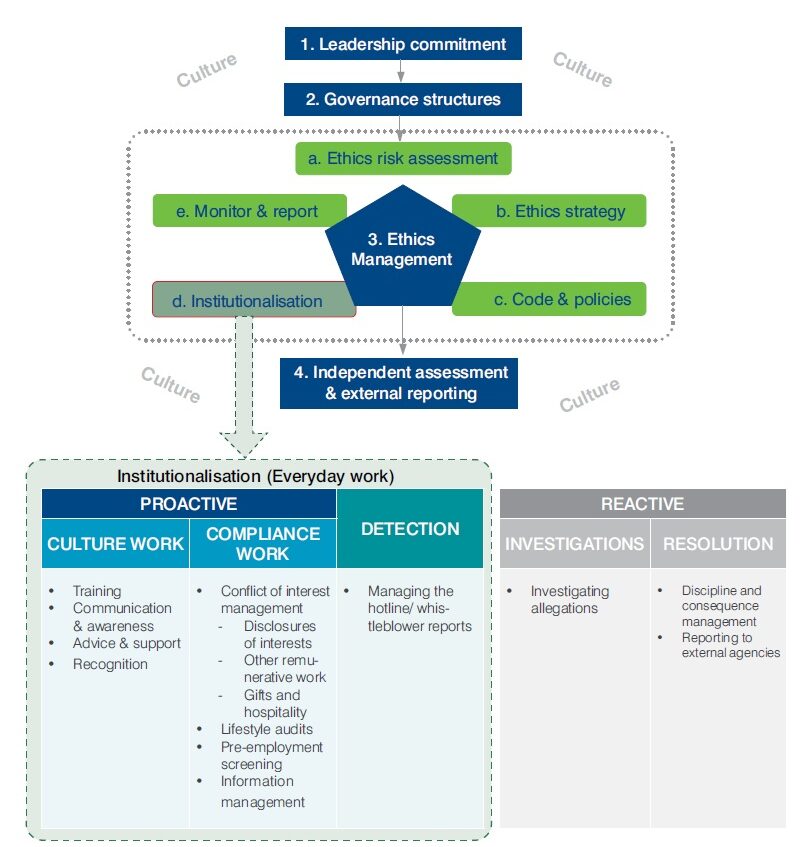
The short answer is that we manage ethics in our departments and municipalities in order to promote an overall ethical culture in the public sector.
An ethical and professional public sector will be more effective at achieving its objectives, and will be less susceptible to corruption.
Government’s ethics management journey actually began with a focus on anti-corruption work. The emphasis was on preventing negative behaviours, however, it became clear that we also needed to focus on promoting positive behaviour that we wanted to see.
When we talk about ethics management, we are no longer just policing unethical behaviour; we are also trying to promote ethical behaviour as the norm.
The work of the ethics officer is predominantly to promote ethical behaviours in their organisation. There are also responsibilities for diligence, to notice when things go wrong, and for ensuring discipline, but the main mindset should be: “How can I contribute to building an ethical culture in my organisation?”
It is important to constantly make members of any organisation or institution aware of their ethical obligation towards others, their organisation and community. Managing ethics is an ongoing process, and if you really want to make ethics work in practice, then you need to shift your focus to promoting an ethical organisational culture. That is where the real change happens – not just in rules, but in how people think, interact, and make decisions on a daily basis.
Very simply put, an ethical organisational culture is one where it is easier to do the right thing rather than the wrong thing. There is built-in expectation from your peers and from management that you will do your job professionally, and that you will behave ethically.
For example – if there is an organisation where no one keeps track of whether work is done or not, or of what time people arrive in the morning, it is very likely that most people will not be truly productive and will start coming in late. Over time a culture develops where these practices become acceptable and become the norm. As a consequence, it is likely that people will start working in crisis mode, such as a mad rush to spend budgets at the end of the financial year. Because people don’t plan, there will be emergencies, and there will then be constant pressure to bypass policies to speed up work. After a while the policies stop being important. The only thing that is important is doing what the manager says – usually when there is an emergency, or damage has already been done.
Now imagine joining that organisation. How easy (or difficult) will it be for you to do the right thing?
On the other hand, in an organisation that spends significant energy on ensuring that it attracts and appoints the right people, and has good leadership committed to the mandate of the organisation, chances are things will be run more professionally. Delivery will be monitored, people will come in on time, and do what needs to be done. Policies will be important and will be followed to the T.
Now imagine joining that organisation. How easy (or difficult) will it be to do the right thing there? You would likely want to be professional, so as to not stand out as an underperformer.
To get a better understanding of ethical culture, watch the following video from the National School of Government.
When we talk about an ethical culture, it doesn’t just mean not being corrupt. We can divide an ethical culture into three parts:
- Integrity – People behave in an honest and right way and are always transparent about their actions. They have constructive, positive intentions, and do not engage in any form of misconduct, theft or corruption.
- Professionalism – People are competent to do their jobs, and consistently do it to the best of their abilities and with care and courtesy.
- Respect – People treat each other with respect and fairness.
If even one of these aspects is absent from an organisation, it will not be a positive place to work, and will likely be more susceptible to corruption.
Any organisation should implement internal controls to manage its risks and ensure good governance. The internal control environment consists of hard controls and soft controls. The hard controls are the policies and procedures, and the soft controls are the ethical culture of the organisation.
Think of it like this. If your organisation has a policy that everybody must be in the office at 8am, but the culture is that people arrive at any time up to 9:30am, then the policy does not mean much. In terms of managing corruption risk, there is a policy that specifies the procurement process that must be followed. In practice, however, you may find that this process is frequently bypassed or manipulated.
As you can see – it does not help to only focus on the hard controls. We also need to focus on the soft controls, or the ethical culture in which these controls are applied.
In the ethics management framework we link the hard controls to compliance work, and the soft controls to culture work – as follows:
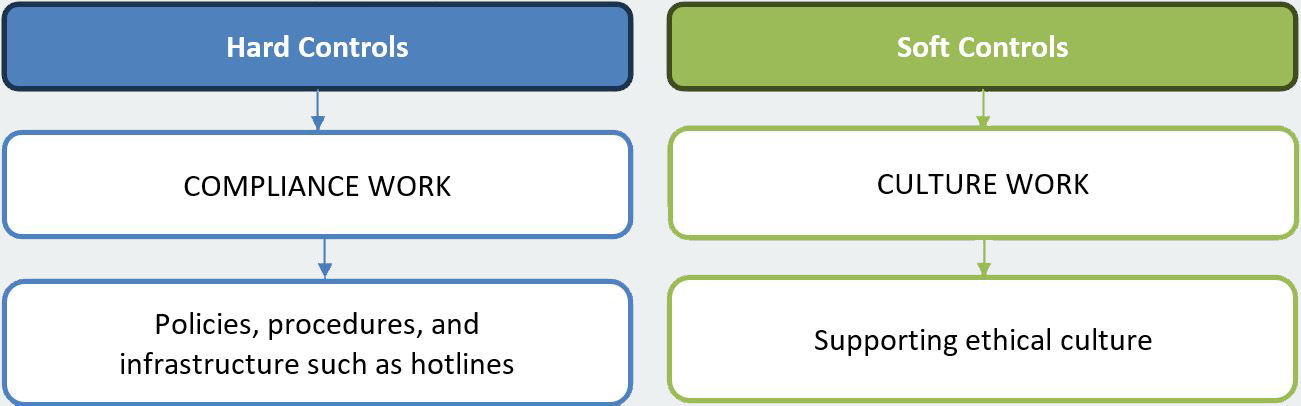
According to an Ethics Management Maturity Assessment conducted in the public service in 2024, ethics officers focus more on their compliance work than on their culture work. This is a natural progression. However, given that it has been almost 10 years since the release of the Public Service Regulations in 2016, it is now time for ethics officers to also start focusing on their culture work.
This guide assists ethics officers by providing guidance on how to focus on both the culture work and the compliance work.
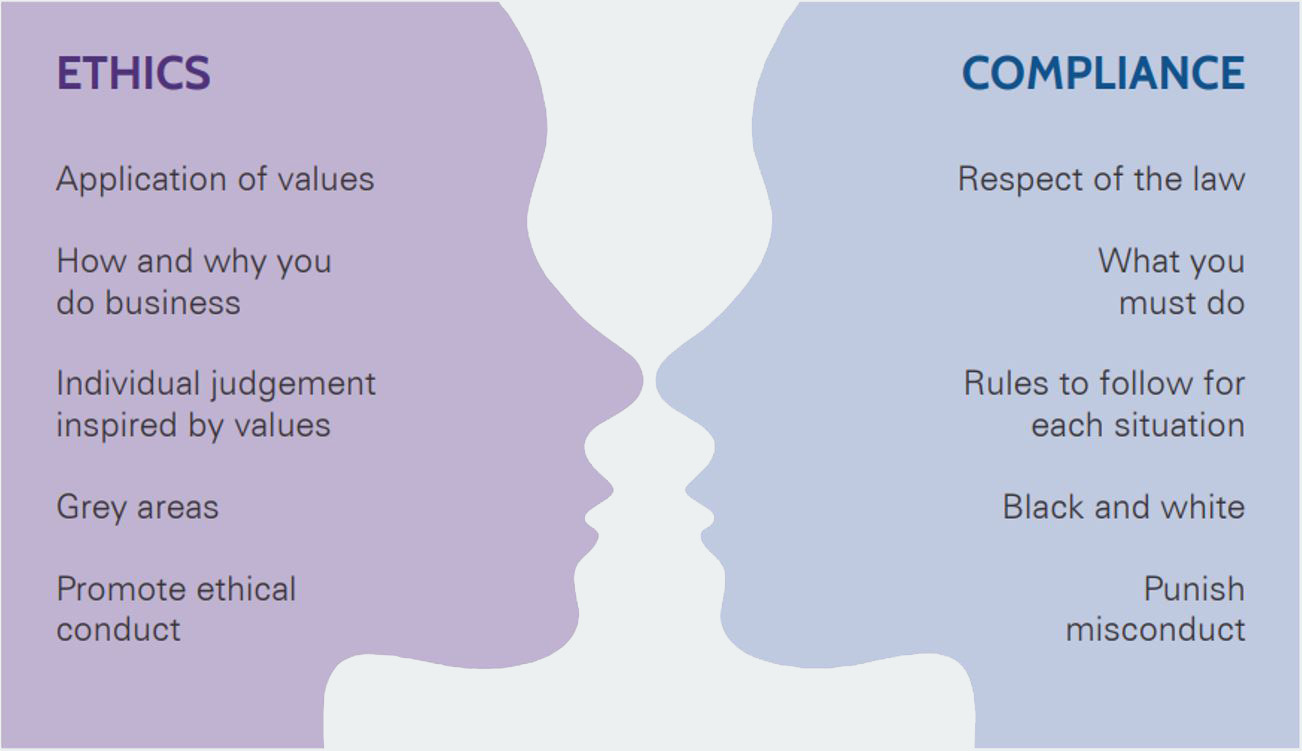
We can say that compliance is doing the right thing when someone is watching, while ethics is doing the right thing when no one is watching.
One could also say that compliance has more to do with following rules, whereas ethics has more to do with aligning with values.
Either way, as indicated above, the ethics officer has both compliance work and culture work. In other words, they have to focus on getting people to comply with certain requirements (such as disclosure requirements), and getting people to behave more ethically overall.
Some organisations have separate compliance officers who make sure that all staff abide by all legislative requirements that apply to their organisation. The ethics officer only focusses on those legislative requirements that relate to ethics management. We explore these laws in the section on the regulatory framework.
The National Anti-Corruption Strategy (2020 – 2030) clearly shows that ethics management plays a key role in anti-corruption work. At the same time, ethics management is not the same as anti-corruption work. This begs the question – what is the difference between ethics management and anti-corruption, and where does one draw the line between them?
Initially, all ethics management requirements flowed from anti-corruption requirements.
This, however, changed in 2013, with the release of the Public Service Integrity Management Framework. This framework was the start of ethics management in the public service as a discipline in its own right. The requirements of the Public Service Integrity Management Framework were almost all taken up in the Public Service Regulations of 2016, so that the Regulations are now the ‘bible’ of ethics management.
Ethics management, however, still has a role to play in anti-corruption initiatives, as illustrated in the following diagrams adapted from The Ethics Institute’s Local Government Ethics Committee Guidebook.
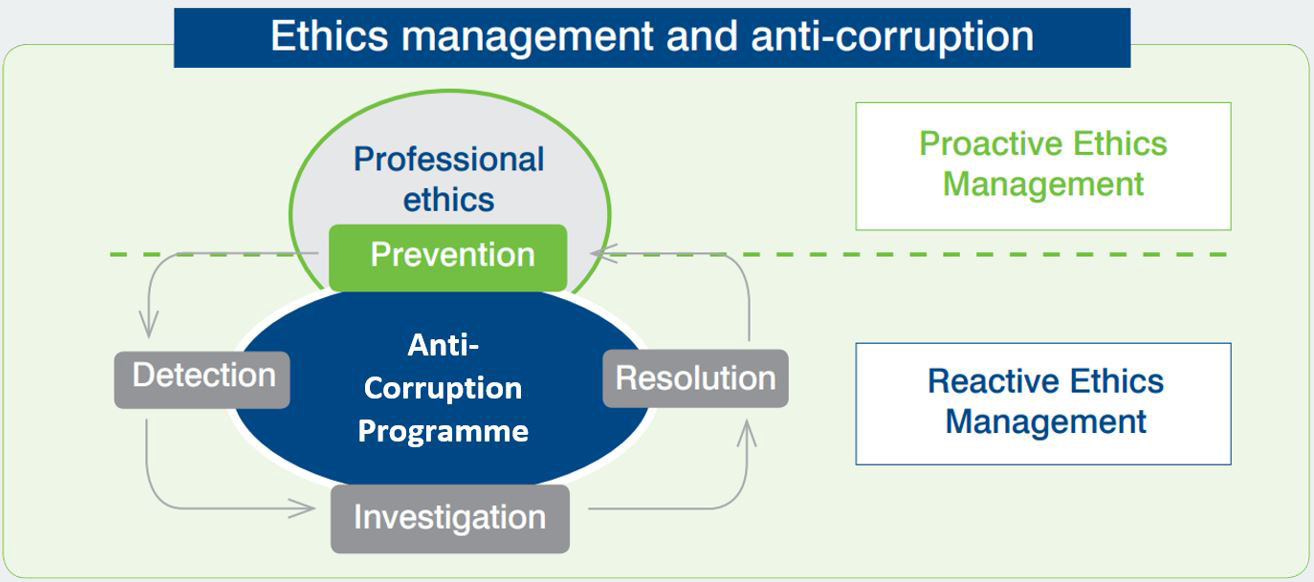
Proactive ethics management focusses on proactively building a professional, ethical culture in the organisation. This is the work of the ethics officer. Building a professional ethical culture is an integral part of anti-corruption initiatives.
Reactive ethics management is more in line with anti-corruption work, and is about managing unethical behaviour (such as corruption) in the organisation. This would be the role of different functions throughout the organisation, such as risk managers, internal auditors, investigators and HR.
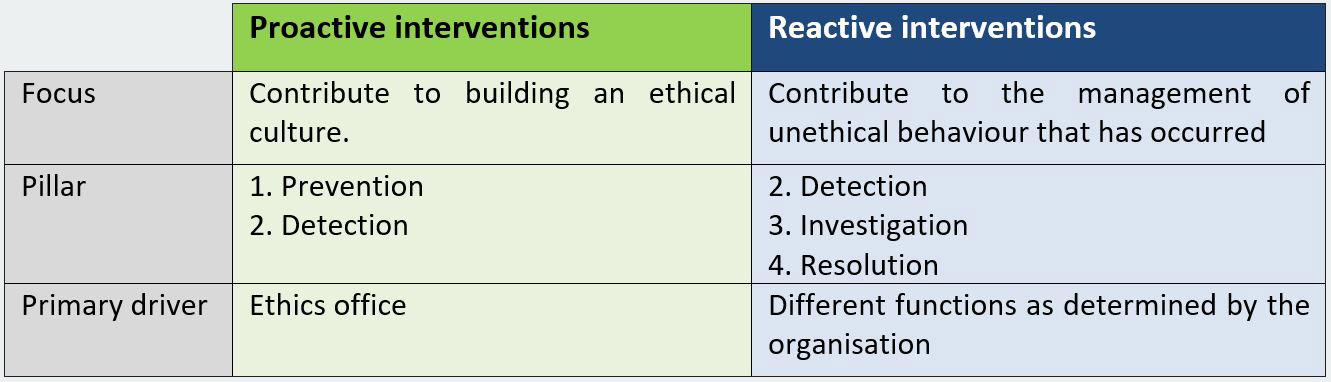
Organisations therefore need to have both proactive as well as reactive ethics management efforts.
For the purposes of the public sector, we generally use these two terms interchangeably. In the public service we tend to talk more about ethics management – the term used in the Public Service Regulations, 2016. In local government, we tend to talk more about integrity management, since these requirements stem from the Municipal Integrity Management Framework.
The overall trend, however, is to move more to talking about ethics management than integrity management.

Strategic Work
Strategic work is done once in 3 years. This work integrates ethics into the organisation’s long-term vision, governance systems, decision making, and stakeholder engagement.

Institutionalisation
Everyday Work
The institutionalisation of ethics is the core role of the ethics officer or the everyday work. The focus of institutionalisation is on how to make ethics real in the organisation so that it becomes part of the organisational culture.
INSTITUTIONALISATION
Making Ethics RealIn The Organisation.
The work of the ethics officer is to manage the ethics programme of the organisation.